
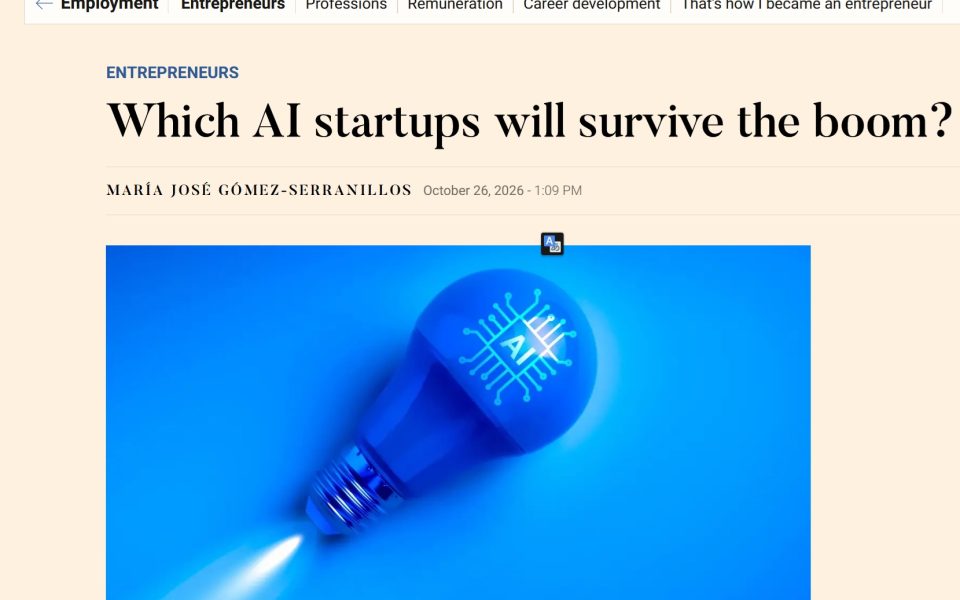
Which AI startups will survive the boom?
Mario Garcés argues that AI startups will outlast the boom by building genuinely differentiated technology, connecting ideas in novel ways, and turning proprietary data into value.…
Read post
ETR · Emotional Theory of Rationality
From black-box prediction to causal, traceable, efficient and adaptive artifical intelligence. A CELL-based cognitive architecture for industrial and regulated systems, on a gated route towards Artifical General Intelligence or AGI.
01De-risked to date
€2.24M
Funding secured since 2021
€700K founders · €1.4M non-dilutive · €140K F&F
€1.4M
Non-dilutive public funding
NEOTEC–CDTI · INVESTIGO · NextGenerationEU · DGA
49%
Of the €5M round committed
State-backed deep-tech investment vehicles
€100K
First paying customer
Pilot project €100K (€40K already
invoiced and paid) · live in 2026
02The problem
Rule-based systems are explicit and auditable, but become rigid when conditions were not anticipated. Statistical and neural systems adapt, but their internal representations are hard to inspect.
In critical or regulated environments, high average accuracy is not enough when operators cannot reconstruct why a decision was made, or how the system will react to a novel condition.
Auditable, but rigid
Every decision is explicit, until reality changes. No learning from experience.
Adaptive and auditable
Learns from experience. Traceability by construction in the Shared Knowledge Graph. Small data, low compute.
Neither
Operator experience and manual control: hard to scale, no systematic trail.
Adaptive, but opaque
Captures non-linear relationships, but the explanation comes after the decision.
Neuro-symbolic hybrids03Why now
EU AI Act high-risk requirements turn traceability, logging, technical documentation and human oversight into procurement issues, not optional extras.
27 Jul 2026
Reg. (EU) 2026/1744 sets the high-risk timetable.
Today
Buyers must adapt procurement and technical documentation before the deadlines.
2 Dec 2027
Annex III systems must comply.
2 Aug 2028
Annex I: medical devices, machinery, vehicles.
04The solution
A cognitive emergent architecture designed to combine adaptability, resource efficiency and native traceability.
small data → regulated, predicted, learned locally → inspectable decision trail
Small data: the current state of the system (signals, events, historian data) instead of a big-data training set.
Small adaptive units keep critical variables in range, predict short- and long-term outcomes and update from experience, under energy and time constraints.
Events, relations, decisions and consequences are written to the Shared Knowledge Graph: the trace is native, not reconstructed post-hoc.
ETR as a product
ETR complements statistical and GenAI components where decisions must remain adaptive, auditable and controllable.

05Capability-gated roadmap
Evolution-inspired, not biologically simulated: each level is a measurable capability, a benchmark and a commercial use case. The upside is capability-gated, not a binary bet.
Productised · ETR 0.5
Reactive regulation
Maintain critical variables and prioritise responses under changing inputs.
Productised · ETR 0.5
Adaptive learning
Learn non-linear action–outcome associations and update behaviour from experience.
Next gate · 2027 · ETR 0.6
Operational causality
Test action–consequence relationships, adapt continuously, remain efficient and traceable.
2028
Context + planning
Episodic context, persistent goals, multi-step planning and anticipation.
2029
Abstraction
Transfer useful structure across tasks; cooperate and coordinate across CELL groups.
AGI target · gated, not dated
General cognition
Open-ended generalisation, language, metacognition and cross-domain reasoning.
Current platform: ETR 0.5 covers WORM and FLY in productised form, with native traceability across both. Next gate: BEE, operational causality (ETR 0.6, 2027). AGI remains the destination; each gate is the investable milestone.
06Applications
ETR ships as a software engine integrated into third-party systems, and complements statistical and GenAI components where decisions must remain adaptive, auditable and controllable.
 Available todayETR 0.5 EngineFully traceable and explainable machine learning for decision-critical systems: industry, medicine, finance or justice.Learn more
 Embodied intelligenceIntelligent roboticsAn operating system that lets robots assist us in tasks that, today, only humans can do.Learn more
 Multidevice intelligencePersonal AAGI assistantA personal intelligence that follows you across devices, learning your goals and context.Learn more
 NPCs that thinkVideogames & virtual worldsAvatars and NPCs with human-like capabilities, running on the player’s device.Learn more
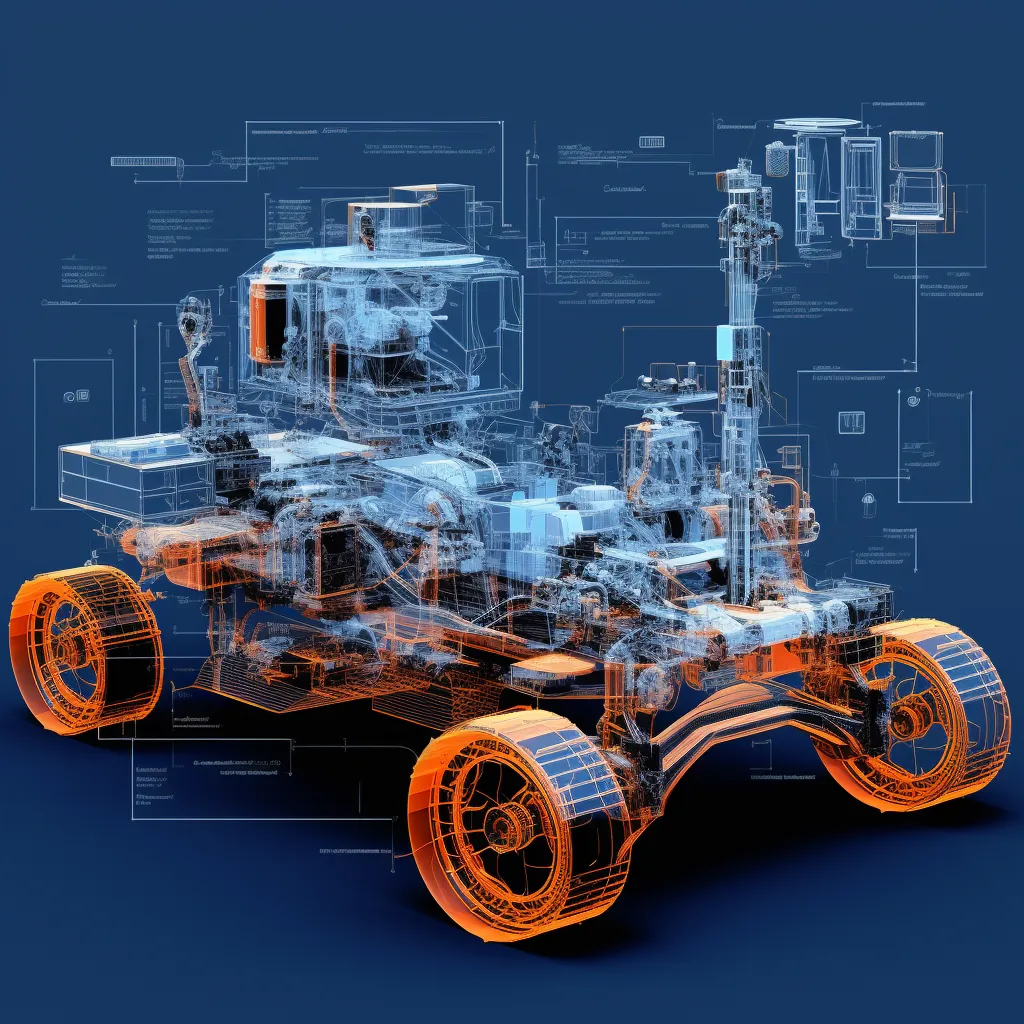 Beyond remote controlAutonomous space explorersFully autonomous robots exploring extraterrestrial environments before human arrival.Learn more
07Scientific foundation
Complex, effective and efficient behaviour emerges from dynamic interaction, context and regulation, not only from adding components.
302
neurons in C. elegans
Its full wiring diagram was mapped in 1986, yet predicting behaviour from that structure alone remains a scientific challenge.
86Bn
neurons in a human brain
Orders of magnitude more components…
20W
…on the power of a dim light bulb
Efficiency comes from regulation, not from count.
“Emotions are the brain’s resource-optimisation and stimulus-prioritisation mechanism: the principle behind ETR’s CELLs.”
08Newsroom
Mario Garcés argues that AI startups will outlast the boom by building genuinely differentiated technology, connecting ideas in novel ways, and turning proprietary data into value.…
Read postThe Mindkind founder contributes to the discussion on the economic and technological limits of current AI scaling and the need to investigate new AI architectures
Read postMario Garcés says an AI pause could expose economic and technical limits, while creating room to test alternative architectures
Read postThe Mindkind
News, announcements and articles from The Mindkind.
We care about your data: read our privacy policy.