· TMK Press team
Beyond Magic and Machines: Mario Garcés Reflects on Human Purpose and Critical Thinking at SIE Huesca 2026
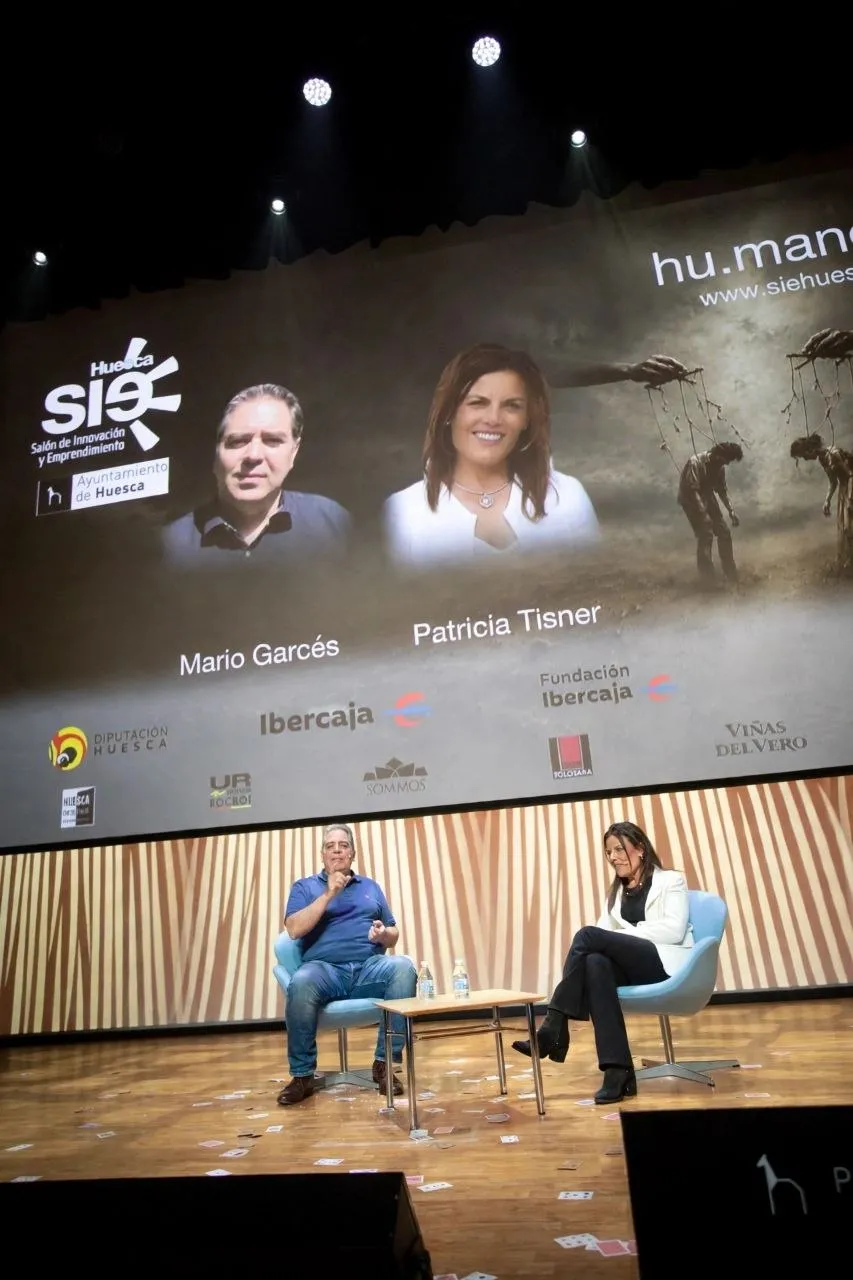
Stepping onto the stage after Jorge Blass to ask a deeper question
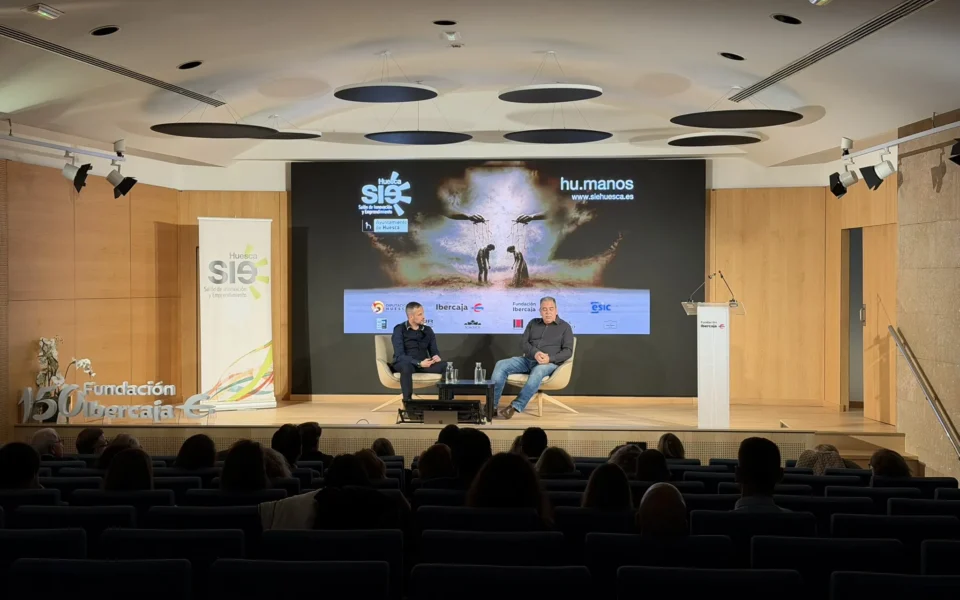
Following world-renowned illusionist Jorge Blass on stage—with playing cards from his performance still scattered across the floor—provided an unexpected backdrop for Mario Garcés, Founder & CEO of The Mindkind, and Patricia Tisner, during the 15th Salón de Innovación y Emprendimiento (SIE Huesca 2026), held on November 19 at the Palacio de Congresos de Huesca under the theme “Hu.manos”.
While magic delights us by playing with perception, Garcés used his conversation with Patricia Tisner to invite the audience—especially the many young people in the room—to look past the spectacle of artificial intelligence and confront a far more profound question: what defines human value when machines can perform every task we once considered uniquely ours?
From the center of the universe to the cognitive revolution
To frame the challenge ahead, Garcés traced a sweeping arc of human history and self-perception. Humanity has repeatedly had to let go of old certainties about its place in the world: first discovering that we are not the center of the universe, and later realizing we are not even the center of our own solar system.
Our relationship with survival and effort evolved along a similar path. We transitioned from hunter-gatherers to farmers and herders; the Industrial Revolution freed us from relying solely on physical strength; and the Digital Revolution accelerated calculation, freeing up routine mental resources. Today, however, artificial intelligence is beginning to replace our core cognitive capabilities—forcing us to rethink not just how we work, but who we are.
The Kasparov lesson: redefining self-worth in the age of AI
Addressing the students and young attendees in the audience directly, Garcés urged them to reflect on their own sense of self-worth in a world where machines will inevitably outperform humans across cognitive domains.
To illustrate this turning point, he recalled the historic 1997 match between world chess champion Garry Kasparov and IBM’s Deep Blue. After losing to the machine, Kasparov spent a decade searching for a new sense of purpose—coming to terms with the reality that, from that moment onward, no human would ever beat a machine at chess again. For Garcés, that moment foreshadows the existential challenge facing today’s youth: learning to define and value themselves not by competing against machines in raw performance, but through deeply human qualities.
The joy of discovery over passive consumption
Rather than allowing younger generations to become mere passive users of technology, Garcés emphasized the urgent need to cultivate the joy of discovery—the intrinsic curiosity to explore, question, and understand how things work.
In an era saturated with instant answers generated by AI, preserving that sense of wonder is not just a personal virtue; it is the foundation of critical thinking. Only by experiencing the pleasure of learning and questioning for themselves will young people develop the judgment needed to scrutinize the information AI provides and remain active authors of their own lives.
Versión en español (para /es/)
Más allá de la magia y las máquinas: Mario Garcés reflexiona sobre el propósito humano y el pensamiento crítico en el SIE Huesca 2026
20 de noviembre de 2026 | TMK Press Team
Subir al escenario tras Jorge Blass para plantear una pregunta esencial
Salir a escena justo después del ilusionista internacional Jorge Blass —con las cartas de su actuación aún repartidas por el suelo— sirvió de punto de partida para la intervención de Mario Garcés, fundador y CEO de The Mindkind, en el XV Salón de Innovación y Emprendimiento (SIE Huesca 2026), celebrado el pasado 19 de noviembre en el Palacio de Congresos de Huesca bajo el lema «Hu.manos».
Si el ilusionismo nos fascina jugando con nuestra percepción, Garcés aprovechó su conversación con Patricia Tisner para invitar al público —y muy especialmente a los jóvenes presentes en la sala— a mirar más allá del espectáculo de la inteligencia artificial y enfrentarse a una cuestión mucho más profunda: ¿cómo nos definimos y valoramos como seres humanos cuando una máquina sea capaz de hacer todo lo que hace una persona?
Del centro del universo a la revolución cognitiva
Para contextualizar este momento histórico, Garcés hizo un recorrido por las grandes transformaciones que han obligado a la humanidad a replantearse su lugar en el mundo. Primero descubrimos que no éramos el centro del universo; después, que ni siquiera éramos el centro del sistema solar.
Nuestra forma de relacionarnos con el esfuerzo y el entorno siguió una evolución paralela: dejamos de ser cazadores-recolectores para convertirnos en ganaderos y agricultores; la Revolución Industrial nos liberó de depender de nuestra fuerza física; y la Revolución Digital aceleró el cálculo, liberando recursos mentales. Hoy, sin embargo, la inteligencia artificial está empezando a sustituir nuestras propias capacidades cognitivas, obligándonos a repensar nuestro papel como individuos y como sociedad.
La lección de Kasparov: reconstruir el sentido propio frente a la máquina
Dirigiéndose especialmente a los jóvenes del auditorio, Garcés insistió en la importancia de que aprendan a definirse y valorarse a sí mismos en un horizonte en el que las máquinas superarán las capacidades cognitivas humanas.
Como ejemplo de ese punto de inflexión, recordó la histórica derrota del campeón mundial de ajedrez Garry Kasparov frente a Deep Blue en 1997. Tras perder contra la máquina, Kasparov tardó diez años en reencontrarse con el sentido de su vida, asumiendo que, a partir de aquel momento, ningún ser humano volvería a ganar jamás a una máquina al ajedrez. Para Garcés, aquella experiencia anticipa el reto vital al que se enfrentan las nuevas generaciones: construir su identidad y su autoestima desde lo genuinamente humano, y no desde la mera competencia funcional con la tecnología.
El placer por el descubrimiento frente al uso pasivo de la tecnología
Frente al riesgo de que las nuevas generaciones se conformen con ser simples usuarios de herramientas tecnológicas, Garcés hizo hincapié en la necesidad de cultivar el placer por el descubrimiento: la curiosidad activa por explorar, hacerse preguntas y comprender el porqué de las cosas.
En un mundo en el que la inteligencia artificial ofrece respuestas inmediatas a cualquier consulta, experimentar el disfrute de descubrir por uno mismo es la única vía para desarrollar una verdadera capacidad crítica frente a la información que nos proporcionan las máquinas y mantener la libertad de criterio.

TMK Press team
press@themindkind.com