

ETR technology
From black-box prediction to causal, traceable and adaptive intelligence.
Our foundational ETR (Emotional Theory of Rationality) cognitive architecture is a CELL-based design, focused on combining adaptability, resource efficiency and native traceability and explainability.


The Black Box problem, solved by architecture
The Black Box is one of the most significant open problems in AI: the opacity of machine learning models whose decision-making processes are difficult to interpret.

Why now: auditability has deadlines
EU AI Act high-risk requirements make traceability, logging, technical documentation and human oversight procurement issues, not optional extras (Digital Omnibus, Reg. (EU) 2026/1744, in force 27 Jul 2026):
2 Dec 2027
Standalone high-risk systems (Annex III).
2 Aug 2028
AI embedded in regulated products (Annex I: medical devices, machinery, vehicles).
The solution: ETR architecture
ETR does not add an explanation layer on top of an opaque model.
Events, relations, decisions and consequences are stored in an inspectable (glass-box) shared knowledge graph as the system operates. Traceability is native to the ETR architecture, not reconstructed after the fact like post-hoc XAI (SHAP, LIME…).
The 'Black Box' issue arises because we don't know where or how AI-specific knowledge is stored (correlations).
Trustworthiness, or the 'Black Swan' phenomenon, is a concern with statistical models, as they can generate nonsensical responses (Long Tails) when confronted with the unknown.
The challenge of adaptability, as it is incapable of conceptualizing and extrapolating available knowledge to address new problems.
The efficiency challenge, as it requires substantial amounts of data, time, energy, and computational resources for learning.
Architecture
The ETR architecture: five differentiating principles
Bio-inspired by a neuroscientific research made by the founder since 2005, it has been scientifically supported by peer-review (Garcés & Finkel 2019), and funded by R&D public grants such as NEOTEC 2021, INVESTIGO 2022, CPP 2022 from Spain's Science Ministery, phase 2 EIC Accelerator, NextGEN (€1.4M since 2021)

1 · Energy/time as the organising constraints
Intelligence treated as efficient resource allocation under energy/time scarcity: what deserves attention, computation and action.

2 · CELL-based architecture
Small adaptive units process bounded information locally and interact through a common mechanism.

3 · Emergent complexity
Global behaviour is not fully programmed in one model; it emerges from the dynamic interaction of multiple CELLs.

4 · Shared Knowledge Graph
Events, relations, decisions and consequences are stored in an inspectable shared space. Traceability is native to the architecture, not reconstructed after the fact like post-hoc XAI (SHAP, LIME…).

5 · Emotions = functional optimisation elements
In ETR, emotions are not feelings: they are the optimisation mechanism that evaluates criticality, prioritises stimuli and allocates scarce cognitive resources (Garcés & Finkel, 2019).

Our "Special Sauce"
Evolution-inspired capability levels
Evolution-inspired, not biologically simulated: each level is a measurable capability, a benchmark and a commercial use case.
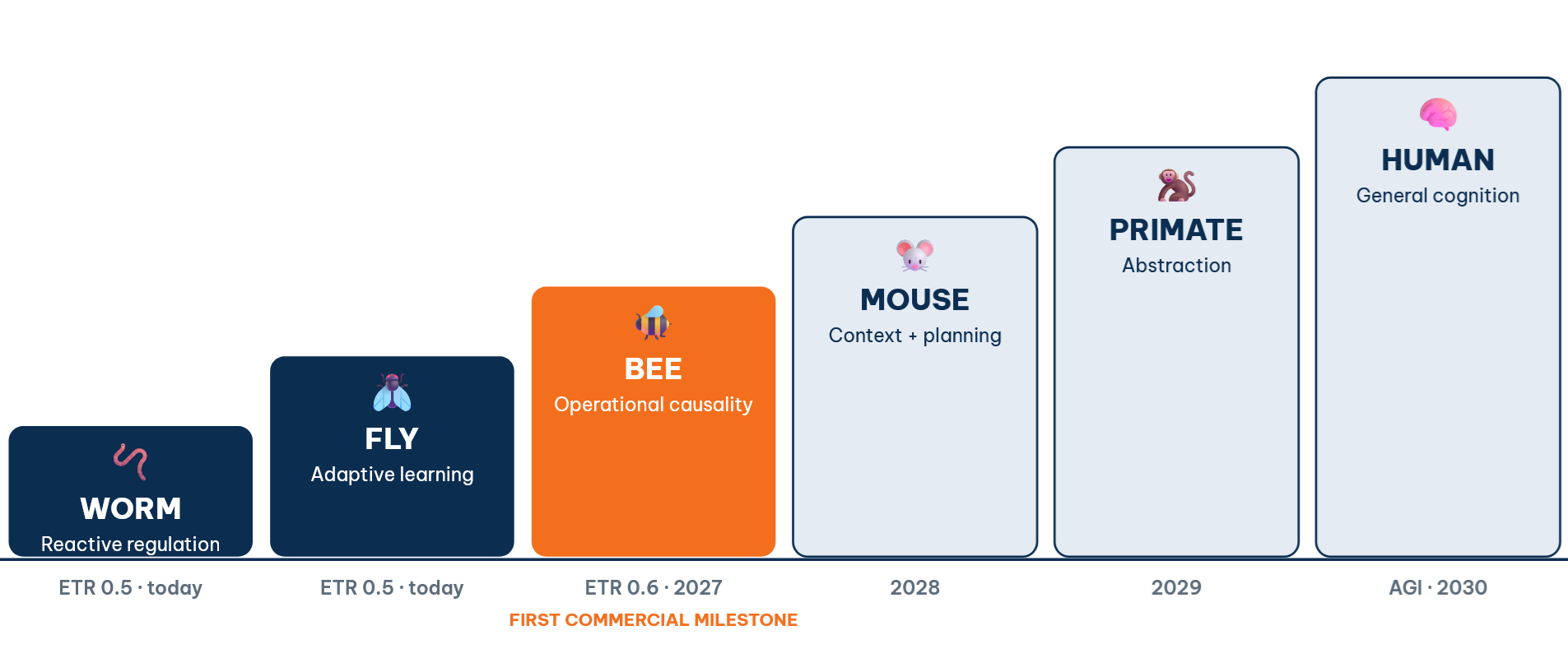
ETR 0.5 covers WORM and FLY in productised form, with native traceability across both. BEE — operational causality — is our first commercial milestone (release ETR 0.6, 2027).
Expected progression BEE (2027) → MOUSE (2028) → PRIMATE (2029) → HUMAN-level general cognition (2030).
302
neurons in C. elegans. Its full wiring diagram was mapped in 1986 (White et al., Philos. Trans. R. Soc. B), yet predicting behaviour from that structure alone remains a scientific challenge.
Evolutionary insight:
Knowing the parts is not understanding the system
The lesson behind ETR: complex, effective and efficient behaviour emerges from dynamic interaction, context and regulation, not only from adding more components.
302
neurons in C. elegans. Its full wiring diagram was mapped in 1986 (White et al., Philos. Trans. R. Soc. B), yet predicting behaviour from that structure alone remains a scientific challenge.
86 Bn
neurons in a human brain…
20 W
…running on the power of a light bulb.
There are infinite applications and we discover more every single day

ETR 0.5 Fullytrazable & explainable
Machine LearningTechnology
Our ETR 0.5 technology offers a solution to the Black Box problem by providing fully traceable and explainable machine learning capabilities. This enables integration into decision-critical systems or systems requiring full explainability, especially in applications such as medicine, finance, industry, or justice.


Meet your multidevice fully "Alive Intelligence"
Envision your personal Artificial General Intelligence that seamlessly accompanies you in your daily interactions with the digital realm, effortlessly integrated into your life, enhancing your experiences and simplifying your tasks.

Videogames
We make sense of the digital environments by bringing Avatars and NPCs to life with human-like capabilities.

Intelligent Robotics
Developing the first AAGI operating system that fully enables robots to assist us in tasks that were previously limited to humans.

Really Autonomous Space-Explorers
Fully AAGI-powered autonomous space robots, initiating exploration and exploitation of extraterrestrial environments prior to human arrival.
Our human-like AI technology for autonomous machines has garnered significant recognition and public funding from EU, national and regional governments.

Latest news
The latest news from TMK and the AI ecosystem.

The Mindkind selected for Creative Destruction Lab – CDL San Sebastián 2026/27
The Mindkind has been selected for the 2026/27 cohort of Creative Destruction Lab (CDL) – San Sebastián, in Artificial Intelligence stream

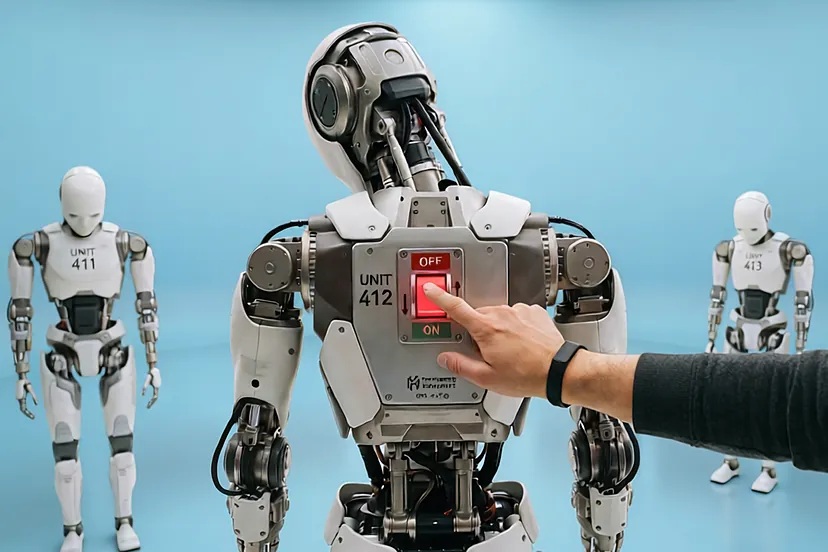
What would you do if AI were to shut down tomorrow?
Garcés says if AI costs exceed its value, firms may stop supporting it, and governments fund the infrastructure if it stays socially useful

Mario Garcés at Scaleups B2B Day 2026: why Algorithmic AI matters in the path to AGI
At Scaleups B2B Day 2026, Mario Garcés brought The MindKind’s AGI vision to business AI—beyond tools, toward ethic general intelligence AGI

The MindKind Wins "Faro AI" Award at ICEX Desafía Day 2026
The Mindkind wins the "Faro AI" Award at Desafía Day 2026 for pioneering Algorithmic Artificial General Intelligence (AAGI) technology.
Stay in the know
Stay up to date with the latest news, announcements, and articles.


Human-like Algorithmic Artificial General Intelligence.

Financiado por la Unión Europea - NextGenerationEU

© 2026 The Mindkind. All rights reserved.

