· TMK Press team
Mario Garcés at Scaleups B2B Day 2026: why Algorithmic AI matters in the path to AGI
At Scaleups B2B Day 2026, Mario Garcés brought The MindKind’s AGI vision to business AI—beyond tools, toward ethic general intelligence AGI
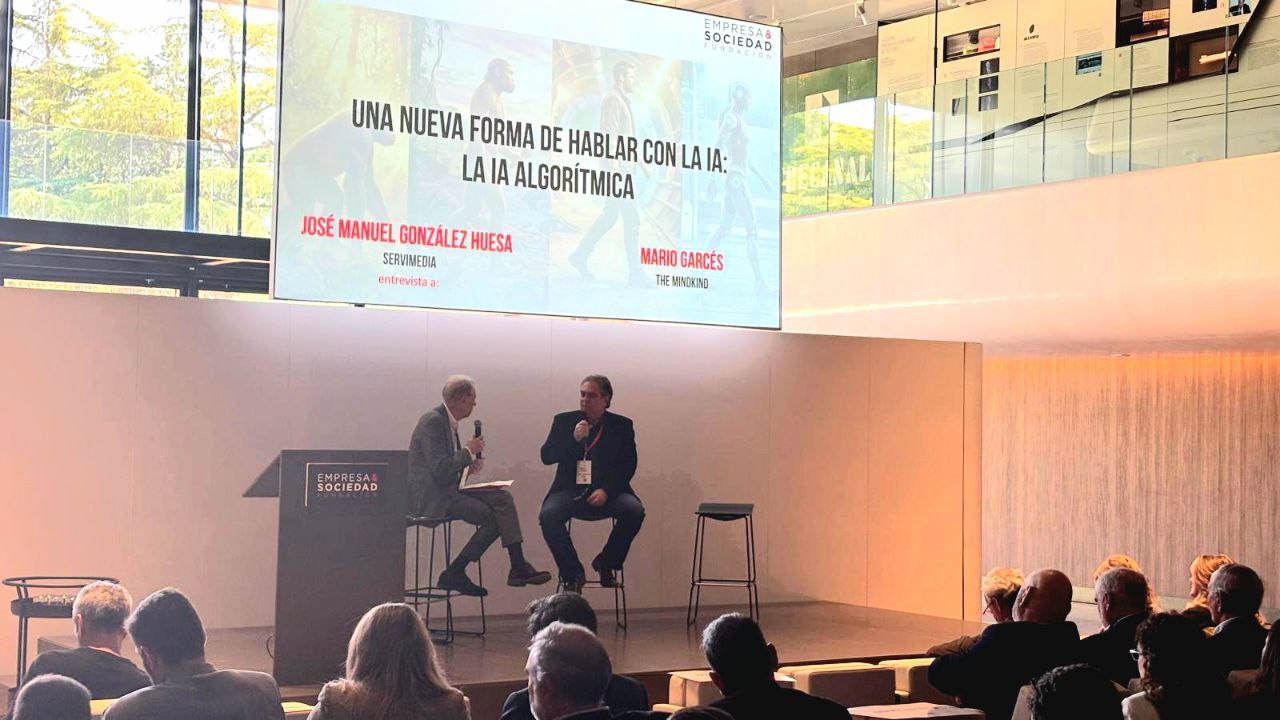
At Scaleups B2B Day 2026 in Madrid, Mario Garcés brought The MindKind’s AGI vision into the conversation on business AI: the future will not be shaped by tools alone, but by the architectures, criteria and decision models that make more general intelligence possible.
At Scaleups B2B Day 2026, organised by Fundación Empresa y Sociedad in Madrid, Mario Garcés, CEO of The MindKind, joined the programme with a session titled “A new way of talking to AI: Algorithmic AI.” The conversation offered more than a reflection on current AI adoption. It also introduced a broader perspective that is central to The MindKind’s work: how today’s debate on AI interfaces, decision systems and human judgement connects to the longer-term challenge of Artificial General Intelligence.
While much of the market conversation around AI is still dominated by generative tools and short-term productivity gains, The MindKind’s approach points in a different direction. The company positions itself around human-level Algorithmic Artificial General Intelligence, with a focus on cognitive architectures designed to support learning, reasoning, decision-making and human-like behaviour across contexts. From that perspective, Algorithmic AI is not just another way to optimise workflows; it is part of a deeper effort to rethink how intelligence is structured and applied.
This is what made Mario Garcés’ participation especially relevant. His intervention placed the emphasis not only on what AI can do today, but on the kind of foundations companies should be paying attention to if they want to understand where AI is heading next. If the future of the sector moves toward more general, adaptive and context-aware systems, then the real question for business leaders is no longer limited to adoption. It becomes a question of architecture, governance and decision quality.
A first takeaway from the session is that organisations need more than AI implementation plans; they need a framework for judgement. As AI becomes embedded in more business processes, the value will not come from automation alone, but from knowing how systems are guided, evaluated and aligned with human goals.
A second takeaway is that the conversation about AGI should not be treated as distant or purely speculative. For The MindKind, AGI is not a rhetorical horizon but a strategic research direction. That gives additional meaning to the idea of Algorithmic AI: it suggests that the way we design and interact with intelligent systems today may influence the path toward more general intelligence tomorrow.
A third takeaway is that human responsibility becomes even more important as systems become more capable. In environments shaped by risk, ambiguity and irreversible consequences, the differentiator will not simply be access to AI, but the ability to combine machine capability with accountable human judgement.
Mario Garcés’ contribution at Scaleups B2B Day 2026 reinforced a message that is increasingly important for leaders: the future of AI will not be defined only by faster outputs or better prompts, but by the quality of the intelligence models behind them — and by whether organisations are prepared for a world in which the AGI conversation is moving closer to business reality.

TMK Press team
press@themindkind.com