Big Tech isn't just selling you a chatbot; they are extracting the procedural wisdom of millions to build the next generation of AI meta-models.
Since the explosion of LLMs, the global conversation has been trapped in a binary debate: obsessing over the limitations of current Generative AI or speculating about the distant arrival of Artificial General Intelligence (AGI).
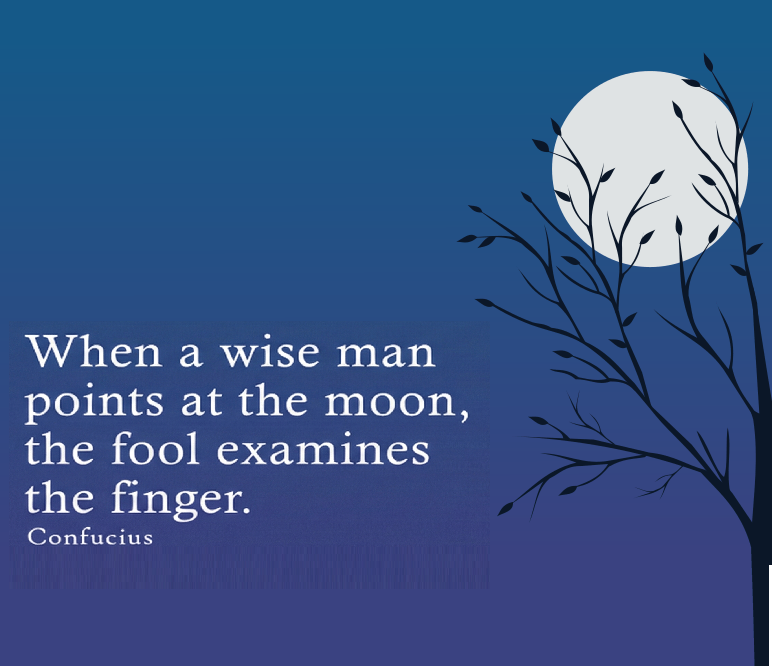
It brings to mind: "When a finger points at the moon, the fool looks at the finger."
Regarding the introductory old proverb about the Moon and the finger, in our current reality, AGI is the Moon - the shiny, hypnotic object capturing the world's attention. Generative AI is the finger pointing toward it. But while the audience debates the finger and stares at the moon, they miss what is happening in the shadows. The real magic trick isn't on stage at all; it's the invisible mechanics operating behind the dark curtain.
Every time a consultant uploads proprietary documents to ChatGPT, a lawyer refines a legal strategy with Claude, or an engineer debugs code with Copilot, something invisible happens: procedural knowledge - the irreplaceable know-how accumulated over careers - flows from individual experts to corporate AI systems. This isn't a future scenario. It's happening now, at scale, and the economics make it nearly impossible to opt out.
The LLM providers understand this perfectly. That's why they're collectively investing over $300 billion annually in infrastructure, something that many analysts tag as an "AI bubble". It is not. They're not just building chatbots. They're constructing the largest knowledge extraction operation in human history - and most professionals remain oblivious to what they're surrendering.
They're constructing the largest knowledge extraction operation in human history - and most professionals remain oblivious to what they're surrendering.
The consultant's dilemma reveals the trap
Consider an aquaculture consultant with 25 years of specialized expertise. She wants to use Retrieval-Augmented Generation (RAG) to query her proprietary documentation - site assessment protocols, disease management frameworks, proprietary feeding algorithms developed over decades. The promise is compelling: an AI assistant that combines her accumulated wisdom with powerful language capabilities.
The problem is existential. Using commercial LLMs like ChatGPT or Gemini means her documentation and, crucially, her working methodology enters systems that train on user interactions. OpenAI's privacy policy states plainly: "We may use Content you provide us to improve our Services, for example to train the models that power ChatGPT." Google's Gemini privacy hub warns users not to "enter confidential information that you wouldn't want a reviewer to see or Google to use to improve our services."
The data shows the scale: OpenAI now has 700 million weekly users, each interaction potentially improving their models at zero marginal cost. Every prompt, every refinement, every professional judgment expressed through these systems feeds a flywheel where more usage generates better models, which attract more users, which capture more expertise.
Enterprise tiers offer protection - none of the major providers train on enterprise customer data by default. But enterprise pricing sits well beyond most professionals' reach. ChatGPT Enterprise costs "dozens to hundreds of dollars per user per month," while Microsoft 365 Copilot runs $30 per user monthly before accounting for infrastructure requirements.
The infrastructure cost barrier forces the choice
The alternative - running private LLM infrastructure - reveals why professionals face a Hobson's choice. A single NVIDIA H100 GPU costs $25,000-$40,000. A complete 8-GPU enterprise server system runs $200,000-$400,000. Add networking ($20,000-$100,000 for switches), power infrastructure ($10,000-$50,000), maintenance contracts ($20,000-$50,000 annually), and the specialized engineering talent required to operate these systems.
Carnegie Mellon researchers found that private LLM deployment only becomes economically viable for organizations processing more than 50 million tokens monthly with sustained 24/7 usage patterns. For smaller operations, break-even against commercial alternatives can take 34 to 69 months - assuming the technology doesn't shift beneath you.
The result is predictable. 78% of organizations now use AI in at least one business function, up from 55% just twelve months ago. 91% of US tech workers have used an LLM for work. The vast majority use commercial services. They have no practical alternative.
This isn't accidental. It's the business model.
Displacement is already underway across professions
The consequences of this knowledge transfer are materializing faster than most anticipated. In July 2025, Microsoft laid off 32 lawyers from its legal department, with reports suggesting up to 465 legal positions could be affected. Morgan Stanley confirmed in March 2025 that some of its 2,000 planned layoffs were "because AI has automated their roles." DBS Bank in Singapore announced 4,000 position cuts - the first major Asian bank explicitly acknowledging AI-driven workforce optimization.
The creative industries face sharper disruption. A Society of Authors survey found 26% of illustrators had already lost work to generative AI, with 37% experiencing income decline. Translators fared worse: 36% reported lost work, 43% saw income decrease. Upwork data shows freelance writing jobs declined 33% following ChatGPT's release, translation jobs dropped 19%, and customer service positions fell 16%.
The entry-level impact is particularly stark. Stanford's Digital Economy Lab found entry-level hiring in AI-exposed jobs dropped 13% since LLMs proliferated. Goldman Sachs research shows unemployment among college-educated Americans ages 22–27 hit 5.8% in March 2025 - the highest in four years. The traditional apprenticeship model, where junior workers learn procedural knowledge from seniors, is being disrupted before those workers acquire the expertise that once took years to develop.
McKinsey - itself a major driver of AI adoption consulting - has cut over 5,000 jobs since 2023, with internal documents revealing AI agents now automate work "previously done by junior consultants: summarizing documents, building slide decks, analyzing data, checking logic, generating first drafts." The irony is palpable: consulting firms selling AI transformation are experiencing it themselves.
The trillion-dollar infrastructure race reveals the stakes
The investment scale illuminates what's really happening. OpenAI has raised $57.9 billion and achieved a $500 billion valuation - an 18x increase from $29 billion in early 2023. The Stargate Project, announced in January 2025, commits $500 billion over four years to AI infrastructure, with five data center sites already under development totaling 7 gigawatts of capacity.
Microsoft is spending $80 billion on AI data centers in fiscal 2025 alone. Google's capital expenditure hit $52.5 billion in 2024 and will reach $75 billion in 2025. Combined, the major hyperscalers - Microsoft, Google, Amazon, Meta - spent over $125 billion on AI data centers in just the first eight months of 2024.
"There is no way."
That is the verdict from Arvind Krishna, who has led IBM since 2020. He argues that even a basic calculation exposes the economic flaw in the industry's current path: the astronomical energy demands and capital costs of new data centers mean these massive investments simply do not make sense. Maybe he is only looking at the finger, or even the Moon… but not the business.
This isn't corporate exuberance. It's strategic positioning for a transformation these companies understand better than their users. As Google CEO Sundar Pichai stated: "The risk of under-investing is dramatically greater than the risk of over-investing." They're racing to capture something they've identified as extraordinarily valuable: the procedural knowledge of hundreds of millions of professionals.
The data flywheel creates a self-reinforcing advantage. Every user interaction improves the models. Better models attract more users. More users generate more training signal. The companies investing most heavily today will control the most sophisticated knowledge repositories tomorrow - repositories built substantially from the expertise their users contributed unwittingly.
Know-how is being redistributed at unprecedented scale
The most profound shift isn't job displacement - it's value transfer. When a trademark attorney spends a weekend using an LLM to complete opposition research that previously required specialized training, something changes permanently. The procedural knowledge - the judgment calls, the research patterns, the professional heuristics - gets encoded into systems accessible to anyone.
This democratization sounds positive until you realize the asymmetry. The professional loses competitive advantage. The LLM company gains training signal worth billions. The user pays for the privilege - either through subscription fees or, if using free tiers, through data that trains models they don't own.
OpenAI and University of Pennsylvania researchers found that 80% of the US workforce could have at least 10% of their tasks affected by LLMs, with 19% of workers potentially seeing half or more of their tasks impacted. The higher your income and the more specialized your knowledge work, the greater your exposure. This inverts traditional automation patterns, where lower-wage physical labor faced the greatest disruption.
The professionals most vulnerable are precisely those whose expertise represents the greatest training value: consultants, analysts, lawyers, doctors, engineers, researchers. Their procedural knowledge - how to structure a deal, diagnose a condition, debug a system, win a case - is exactly what these meta-models need to become more capable.
This transformation precedes artificial general intelligence
The most disorienting aspect of this shift is that it's occurring with current technology - before any meaningful progress toward artificial general intelligence. GPT-5 and Claude-4 aren't AGI. They're sophisticated pattern-matching systems trained on human knowledge and continuously refined through human interaction. Yet they're already restructuring labor markets, redistributing professional value, and concentrating knowledge assets in a handful of companies. AGI can arrive or not, but know-how extraction is already here.
The World Economic Forum estimates 44% of workers' skills will be disrupted in the next five years. Bloomberg Intelligence projects 200,000 Wall Street jobs at risk in the next three to five years. The entertainment industry expects 20% of jobs - approximately 118,500 positions - eliminated by 2026.
These aren't speculative futures. They're near-term projections based on current capabilities. Whatever comes next - whether genuine AGI or simply more capable narrow AI - will accelerate dynamics already in motion.
The Disney paradox exposes the contradiction at scale
Perhaps nothing illustrates the twisted economics of AI knowledge extraction better than Disney's schizophrenic response to intellectual property theft. In June 2025, Disney and Universal became the first major Hollywood studios to sue an AI company, filing copyright infringement charges against Midjourney for allowing users to generate images of Mickey Mouse, Spider-Man, and other iconic characters. Disney's chief legal officer declared: "Piracy is piracy, and the fact that it's done by an AI company does not make it any less infringing."
Disney followed with cease-and-desist letters to Meta and Character.AI. In December 2025, the company sent Google a scathing letter accusing the search giant of copyright infringement "on a massive scale," calling Google's AI services a "virtual vending machine" for Disney's intellectual property and demanding immediate removal of all infringing content.
Then came the plot twist that reveals everything.
Six months after suing Midjourney for stealing their IP, and one day after threatening Google with legal action, Disney announced a $1 billion investment in OpenAI - a company that built its models by training on copyrighted content including Disney's own properties without permission or compensation. The three-year licensing deal gives OpenAI's Sora video generator official access to over 200 Disney characters from Marvel, Pixar, and Star Wars franchises.
The Writers Guild of America immediately condemned the deal: "Disney's announcement with OpenAI appears to sanction its theft of our work and cedes the value of what we create to a tech company that has built its business off our backs." The Animation Guild noted that animators who created these beloved characters "have never received compensation for the licensing of these characters, nor will they benefit from the user-generated content made from AI powered by their creativity and labor."
The message is clear: if you can't beat the knowledge extractors, join them - and try to monetize what they've already taken. Disney chose to legitimize OpenAI's approach rather than fight it, presumably calculating that a $1 billion investment and licensing fees beat watching users generate Disney content on platforms they don't control. The original creators whose work trained these systems get nothing.
This is the endgame of knowledge extraction: even the most aggressive defenders of intellectual property ultimately surrender to the economic reality. If Disney—famous for suing birthday party entertainers for wearing unlicensed Mickey Mouse costumes—can't maintain control of its own IP against AI platforms, what chance does an individual professional have?
The invisible extraction demands visibility
The central problem isn't that AI is improving or that work is changing. It's that the terms of exchange remain hidden from most participants. Professionals using commercial LLMs are surrendering procedural knowledge - expertise that took years to develop - in exchange for convenience. The companies collecting this knowledge are building multi-hundred-billion-dollar enterprises on the foundation of that transfer.
Italy's data protection authority fined OpenAI €15 million for GDPR violations, but regulatory responses remain far behind the technology's impact. Users can opt out of training data collection, but the mechanisms are buried in settings, and opting out often means losing functionality.
The aquaculture consultant faces an impossible choice: maintain competitive advantage by avoiding AI tools while competitors adopt them, or surrender expertise to systems that will eventually make her specialized knowledge commonplace. Across every knowledge profession, similar calculations are happening - mostly without recognition of what's actually being exchanged.
What comes next
What's needed isn't resistance to AI but clarity about the transaction. When you upload documents to a commercial LLM, you're not just getting help with a task. You're contributing to a knowledge repository that may eventually compete with your expertise. When you refine AI outputs through iteration, you're training systems to better approximate your judgment. When your employer mandates AI tool adoption, they're participating in a value transfer whose beneficiaries sit in San Francisco, Seattle, and Mountain View.
Understanding this dynamic won't stop it - the economics are too compelling, the technology too useful. But visibility might change how professionals negotiate, how organizations approach AI adoption, and how societies regulate a transformation that's already underway.
The first step is recognizing that your expertise isn't just being assisted. It's being harvested.