While generative artificial intelligence is already disrupting the job market, the imminent arrival of general artificial intelligence promises a total revolution and demands a new social contract to confront the end of traditional work and numerous professional challenges.
As we are still grappling with the promises and uncertainties of generative AI—and how these tools can change our lives, careers, and jobs—some are already speaking about the possibility of achieving general artificial intelligence, a step beyond toward the supposed goal of superintelligence.
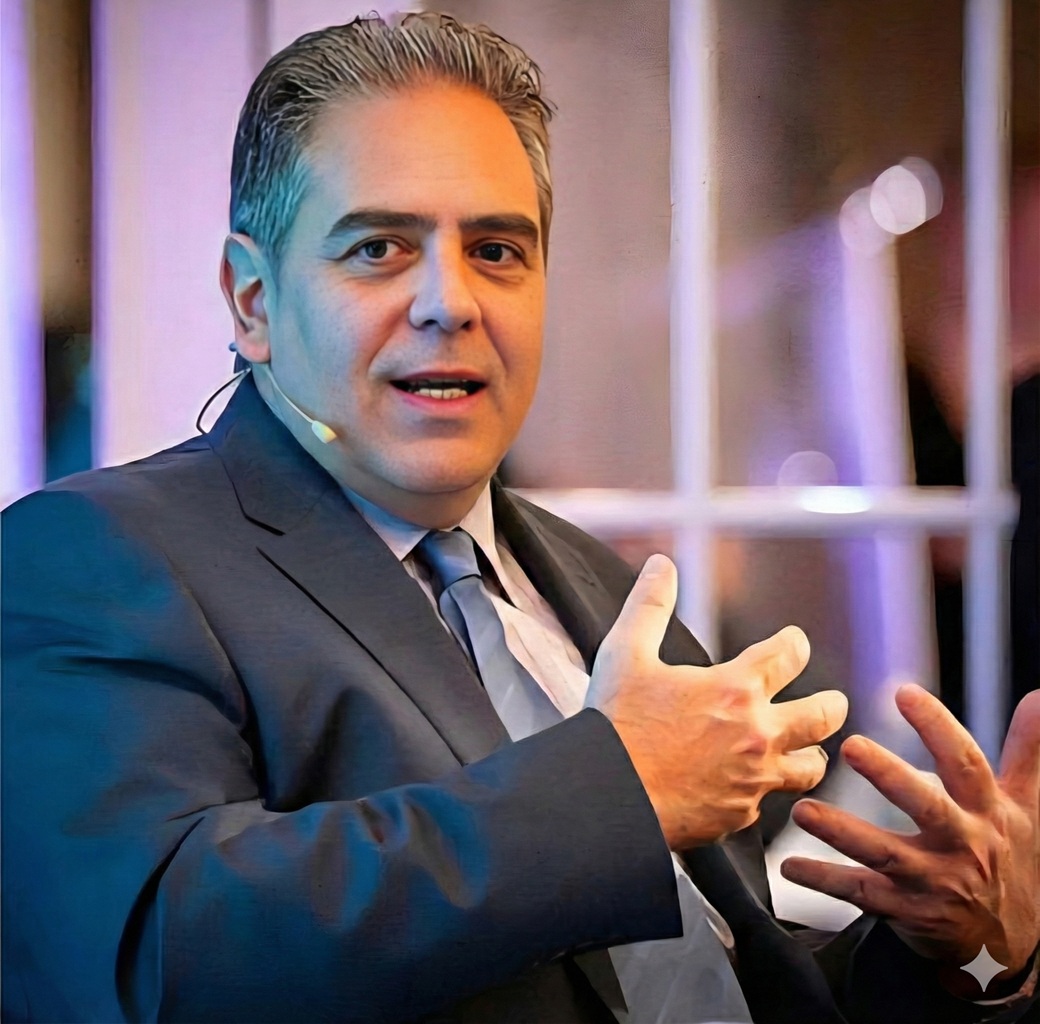
Mario Garcés, entrepreneur and researcher in neuroscience and algorithmic general artificial intelligence, has founded The Mindkind, a startup seeking general AI: an AI that understands, learns, thinks, and adapts like a human in any subject.
While current AIs are only good at specific tasks (translating, writing, playing chess, generating images), general AI would be good at everything, solving new problems, reasoning, planning, learning by itself, and applying what it learns in any situation. Garcés is competing with Sam Altman, Google, and Microsoft in this quest for the Holy Grail of intelligence.
The founder of The Mindkind debated this week during the XXIII EXPANSIÓN Awards for Innovation in Human Resources with Felipe Navío, co-founder and co-CEO of Job&Talent, one of Spain’s employment unicorns and an example of a new actor in recruitment and job search.
A Trivial Example With Big Implications
Garcés began the conversation imagining “the case of someone returning home at night, on deserted streets. They stop at a red light. No one is crossing, no cars are coming, and yet they stay put, obeying the signal.” Something as simple as a traffic light is a critical infrastructure—and because of that, we can’t put today’s AI in charge of managing it. “It’s not trustworthy.”
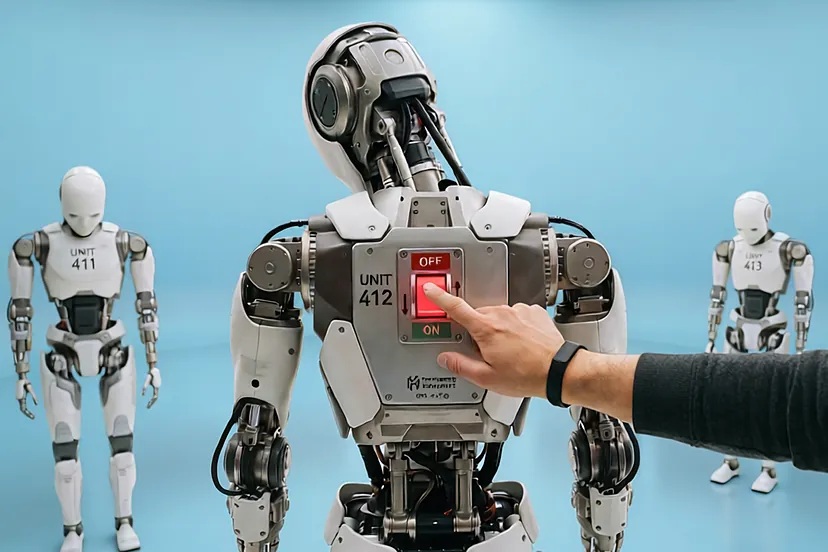
From this seemingly trivial example, he launched into a debate about the present of generative AI and the future of general AI. Its arrival, he said, will not be just another tool but “an event with the impact of a meteorite: inevitable, transformative, and fast.”
He breaks down the myth of current AI: “The technology that has fascinated the world over the past two years—ChatGPT, image generators—is generative AI. These systems are, essentially, large statistical models born from big data.”
They grind massive databases through layers of artificial neural networks, seeking complex statistical correlations. Their results may seem magical, but Garcés warns about the ‘black box’ problem: we don’t know what they truly learn or how they reach conclusions. They do not generalize knowledge; they only reproduce what they’ve been taught—with all its biases.
“No one in their right mind would put an LLM in charge of an air traffic control tower or a construction crane.”
The Holy Grail: Machines That Learn to Learn
The objective pursued by giants like Google, Microsoft, and OpenAI—and the one Garcés works on from a neuroscientific perspective—is general artificial intelligence (AGI). The qualitative leap lies in “creating a machine capable of learning to learn, emulating the masterful efficiency of living beings.”
Datacenters consume enough energy to light up cities, whereas the human brain learns, extrapolates, and solves novel problems with just 20 watts.
HR as a Laboratory of Change
While science tries to replicate biological efficiency, the labor market is already experiencing its first tremors.
From the perspective of Job&Talent, Felipe Navío says: “The change isn’t coming—it’s already happening.”
He believes many companies fall into “paralysis by analysis,” afraid of not being experts in AI. “AI is so new that many who say ‘I know AI’ probably don’t. And if they do, tomorrow they won’t, because another model will come out.”
To illustrate the real impact, he presented Clara, a virtual recruiter developed after the emergence of ChatGPT. What began as a playful experiment is now fundamental: Clara manages 400,000 hires and four million interviews per year.
Candidates who once waited weeks—or were forgotten—can now be contacted within 60 seconds of applying. Clara provides 20-minute interviews that capture far richer information than static forms.
Navío emphasizes the paradox: “Technology has humanized the service by making it immediate and attentive.”
The Meteorite Is Coming Fast
To think about the medium-term future, Garcés returns to the meteorite metaphor: “We know a technology capable of doing all human work will arrive. The problem with a bullet isn’t the bullet—it’s the speed.”
The concern is not its existence, but the rapid deployment that leaves little time for social and economic adaptation.
Recent US data shows unemployment among new university graduates has doubled from 5% to 9% in the last quarter. Junior skilled roles—the traditional entry point into the workforce—are being replaced first by efficient, cheap language models.
The arrival of models like DeepSeek has changed the rules: cutting-edge AI no longer requires billionaire investments. Low-cost, high-performance models are collapsing the barrier to entry and accelerating the timeline dramatically.
Where Do Humans Fit In?
If machines solve everything and everyone has access to their solutions, what is left for humans?
Navío compares employment to energy: “It’s not created or destroyed—it transforms.”
While some jobs will vanish, he notes the rise of solopreneurs—the number of people launching solo ventures has multiplied one hundredfold in the last year.
Maybe the future won’t have 2 billion employees but 2 billion entrepreneurs.
AI is democratizing creation: tasks that once required programming knowledge, factories, or entire teams can now be done by a single person with an idea.
Navío says, “We’re entering the era of creativity.”
Garcés offers a more philosophical view. After 15 years doing basic neuroscience research—often in isolation—he believes humans are defined by their capacity for thought. Modern society leaves little room for contemplation or intellectual curiosity. Total automation might free us to recover that essence.
The Nature of Learning Will Shift Forever
Garcés highlights a chilling idea: mastering any discipline takes a human about 10,000 hours of practice—slow and non-transferable. Machines operate differently. If one machine learns what he knows about AI, all machines can instantly learn it.
Digital knowledge can be copied at once. Combine human-like architecture with instantaneous networked knowledge sharing, and superintelligence will surpass human learning scales altogether.
A New Social Contract
Garcés argues we must act: it’s time to discuss a new social contract. Governments and supranational bodies like the EU must design mitigation and adaptation strategies.
If work stops being the backbone of human life, economic and social restructuring will be inevitable.
“We Are Building Cathedrals of Intelligence”
Navío urges action: “We must try things.” The cost of experimenting with cutting-edge technology is barely €20 per month.
Garcés agrees and reveals he personally uses language models for his research. When one knows how to prompt, AI can cross disparate ideas and produce exhaustive reports in real time, “turning weeks of discovery into minutes.”
He concludes:
“Humanity has always grown by pushing itself to the edge. Each technological leap brings crisis and rebirth. The difference now is scale and speed. We are building cathedrals of intelligence, composing symphonies of data, and designing our evolutionary successors—or our greatest allies.”