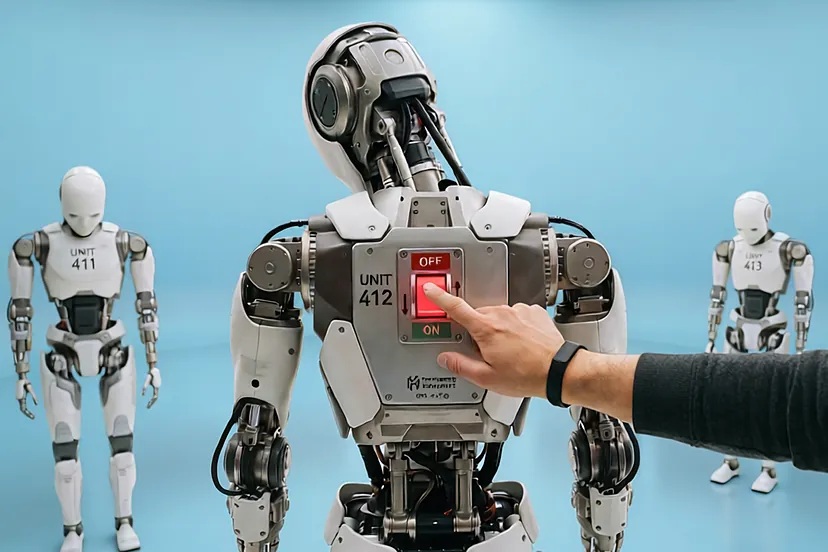
Mario Garcés says an AI pause could expose economic and technical limits, while creating room to test alternative architectures and real productivity.
Spanish business newspaper Expansión has included The Mindkind founder Mario Garcés in its analysis of what a slowdown in AI development could mean for employment, productivity and emerging professions. Garcés argues that the debate may extend beyond safety and provide an opportunity to examine the economic and technical limitations of current approaches, while creating room to investigate alternative AI architectures.
A global moratorium on AI would give the labour market some breathing room. Companies could take advantage of the pause to train their employees, integrating technologies that are currently underused.
The UN has just warned that all human rights “are at risk” in the face of the advance of artificial intelligence. It is the icing on the cake of gloomy predictions that Jacob Coxon (formerly of OpenAI and Anthropic) first put in the oven, announcing the arrival of a superintelligence over which human beings will have no control whatsoever, and which has been followed by Dario Amodei (Anthropic), Sam Altman (OpenAI), Elon Musk (SpaceX) and Demis Hassabis (Google) themselves, with calls to slow down the development of AI.
Regarding this worldwide debate calling for AI to be stopped, The Mindkind founder Mario Garcés says that “money offers one possible explanation for these calls for caution. The suspicion is that companies may fear failing to deliver on their promises to investors, after committing gigantic sums, while Chinese open models compete for their market. Invoking safety would allow them to buy time without acknowledging that the numbers might not add up.”
Garcés adds that “these companies could end up being considered "too big to fail". If their services become essential infrastructure, governments could come under pressure to support them with public money.”
Another explanation would lie in the technical difficulties: that the money invested may not be enough to overcome the reliability problems that make it difficult to delegate critical decisions to these systems.
For Mario Garcés, a pause in AI “would provide room to investigate other architectures and lower expectations without admitting to a dead end. The slowdown could have a useful consequence for those working with these tools: devoting time to making the most of them. Less rush to replace professionals and more attention to where they help, what mistakes they make and how much supervision they need. Consolidating these applications would make it possible to determine which productivity improvements are sustained when the human work of reviewing the results is included.”
Thus, slowing down AI development could ease the pressure on some professionals, but the effect would not be uniform.
A pause could reduce opportunities in activities that are growing precisely around this technology.
The WEF places AI and machine-learning specialists among the fastest-growing professions and estimates that AI can create and destroy jobs simultaneously. Slowing its development could protect some tasks while harming engineers, researchers or new specialists.
If we assume that the pause affects only new models and applications, the transformation of work would not stop. Only 20% of companies in OECD countries were using AI in 2025, so there is still room to adopt tools that are already available. Anthropic’s conclusion is that actual use of AI remains far below its technical capabilities. And giving up certain tools would also have costs.
In employment, some of the pressure to replace professionals would decrease, but so would some of the demand for new hires, and a pause in the development of more powerful AI models could delay some automation plans.
A document from Anthropic signed by Maxim Massenkoff — the company’s head of core economic research — and Peter McCrory — head of economics — has found that “actual AI use still represents only a fraction of what current models are capable of doing, indicating that there is room to expand technologies that are already available.”
An AI moratorium could reduce hiring linked to new projects. It should be remembered that the World Economic Forum places AI and machine-learning specialists among the fastest-growing professions through 2030.
For young people, preserving some entry-level positions could be important. Korn Ferry warns that eliminating them reduces the spaces in which people learn how a company operates.
Skills
AI skills would not automatically lose their value. There would be more time to learn them and less pressure to keep up with every new development.
If a pause allowed current tools to continue being used, companies would still need people capable of operating them, interpreting their results and working with data.
The OECD notes that fewer than 1% of professionals need advanced knowledge to develop AI. For many, digital skills, data analysis and interpretation, and abilities such as problem-solving, creativity and management will be more necessary. Workers who receive training to use AI report better employment outcomes.
A pause in AI could reduce the speed at which some skills become obsolete and would provide more time to learn relatively stable tools.
Nor would the economic advantage of knowing how to use AI disappear. The best professional protection would still be to combine knowledge of the profession, the ability to use AI and one’s own judgement.
Productivity
A pause in the development of new AI models would not make the productivity improvements that some companies have already achieved disappear.
If a tool currently makes it possible to complete more work in less time, that advantage would continue to exist as long as the tool could still be used. The well-known study by Erik Brynjolfsson, Danielle Li and Lindsey Raymond involving 5,172 customer-service agents shows that the use of an AI assistant increases the number of issues resolved per hour by 15%, with a particularly positive impact among less experienced workers.
It is therefore important to distinguish between slowing the development of more powerful models and withdrawing tools that already work. These are two different scenarios.
Furthermore, even without new technological advances, companies could still improve their productivity by learning to use current systems better. McKinsey points out that organisations achieving the best results with AI do not simply introduce it into old processes, but redesign the way work is done.
The main cost of a pause would lie in the future improvements that would be delayed. What cannot be known is how large those gains would be, because there is no real-world experience of a global moratorium.
And as far as working models are concerned, a pause in the most advanced models would not automatically return work to the way it was before. If new autonomous agents were halted, companies would have to keep people coordinating, reviewing and authorising tasks for longer. Google DeepMind acknowledges that increasingly capable agents require more sophisticated safeguards and controls over their actions. Assistants that are already permitted would continue to change teams and redistribute tasks in different ways. Randstad points out that immediate managers continue to play a key role in providing stability in work that is increasingly influenced by AI.
A SLOWDOWN THAT CHANGES HIRING
A pause in AI would temporarily protect certain tasks threatened by automation, but it would primarily harm professionals whose demand is growing thanks to the development of AI itself.
- The first group to suffer would be AI researchers, machine-learning engineers and specialists dedicated to training new models. Their work is directly linked to the technological race. A suspension of new models would cut back or postpone projects and some of the hiring associated with them.
- Close behind are big-data specialists, data engineers, software developers and professionals responsible for integrating AI into products and business processes. If companies were able to continue using current models, they would need professionals capable of connecting them to their databases, applications and processes.
- If the most powerful models were suspended for safety reasons, while current tools remained available, some specialisations would lose projects while others would continue to evolve.
- Some of the professions developing around AI would also suffer: AI product specialists, solution architects, transformation consultants, agent engineers or professionals with advanced AI knowledge.
- In the case of security, evaluation and audit specialists, a pause to assess risks before allowing more advanced models could even increase their importance.
Source: Expansión, Tino Fernández, 16 September 2026.