The debate is opening over whether we are facing the end of employment or the metamorphosis of work. If AI, in addition to “knowing,” is capable of “doing,” it ceases to be a simple consultative copilot and becomes an operational actor. New AI agents absorb the most routine tasks, forcing professionals to redefine their roles. A new automation map is emerging that is changing many jobs.
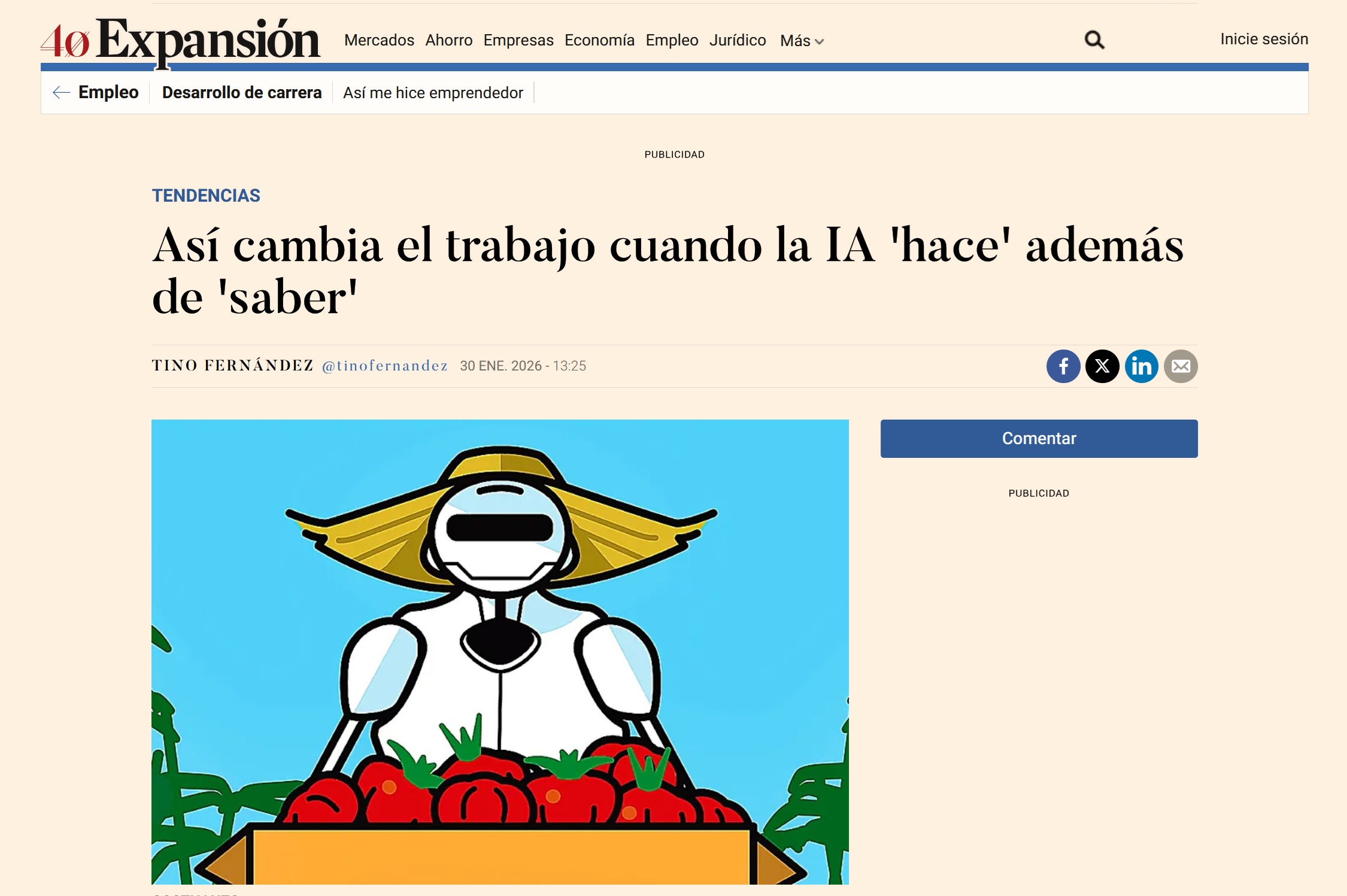
Every 30 minutes, Claude—the artificial intelligence (AI) model created by Anthropic—goes on alert and checks the status of a tomato plant by analyzing certain conditions, such as temperature or soil moisture. It then decides whether to turn cultivation devices on or off (grow lights, a thermal blanket, ventilation, or the irrigation pump). Claude operates the environment, while Martin DeVido, a developer from Los Angeles, is the one who built the biodome in which the plant lives.
All of this is part of an experiment in which artificial intelligence, in addition to “knowing,” is capable of “doing.” Martin DeVido designs and integrates the physical and software system and connects it to Claude, which acts as the decision engine: it reads telemetry, interprets the state of the crop, and orders actions (light, ventilation, heat, irrigation) to maintain the plant.
What is novel here is not watering a tomato plant—this has been automated with timers for decades. What is new is testing a loop of AI agents to observe the state of the environment, decide what to do, execute actions, observe again, and repeat this cycle for weeks.
At this decisive moment for generative AI, on the road toward artificial general intelligence (AGI), the tomato plant experiment created by Martin DeVido in collaboration with Claude’s AI represents a turning point for “hands-on” professions, because it shifts value from manual execution to the autonomous operation of instrumented environments.
It is true that many trades already work with machines (boilers, climate control systems, irrigation, production lines, pumps, compressors, cold-storage rooms). What is new is that the “operator” can become an artificial intelligence agent that monitors tirelessly (and without fatigue) 24 hours a day, seven days a week; detects anomalies before they become visible; executes procedures consistently; prioritizes incidents and coordinates actions; and automatically documents decisions and traceability.
Artificial intelligence agents are the common thread in all this because they are the piece that turns AI from a knowledge tool (answering, writing, recommending) into an operational subject (monitoring, deciding, and executing) within a real system.
Following the ideas of the founder of The Mindkind, Mario Garcés—a Spanish entrepreneur competing with Sam Altman and all the AI giants in the race toward artificial general intelligence—we could say that almost everything we today call “employment” will be automatable or delegable. This does not imply the end of work, but rather its mutation in three directions: from technical execution to ethical and strategic direction; from the production of goods to the production of meaning, culture, and social value; and from competing against machines to collaborating with them.
When agents make it possible for artificial intelligence not only to “know” but also to “do,” AI does not take away our work or our trade—it takes away routine.
The real change and consequence is not unemployment but the redistribution of tasks within each role. Some activities tend to be absorbed, such as monitoring, repetitive adjustments, documentation, simple alarm triage, and routine coordination. Other tasks are reinforced for humans (physical intervention, work in variable environments, complex diagnosis, interaction with people, legal responsibility, and sign-off).
The era of artificial general intelligence will not bring the end of work, but its metamorphosis. It will transform it profoundly. What will remain as valuable human territory will be oriented toward relationships, values, ethics—toward everything that connects technology with human life and organizational purpose.
Machines can process, generate, and automate many jobs, but giving them meaning, ensuring coherence between what we do, why we do it, and how it impacts people will remain a clearly human and strategic domain.
That is why, when mature general AI is capable of programming, designing, researching, and creating art; when it can govern economic and technological systems with minimal supervision; and when it self-corrects and generates new knowledge, in a scenario of mature AGI, humans will have redefined their roles and moved from operators to architects of purpose.
A logical fear
In any case, if an AI agent can observe, decide, act, and verify results, it is normal for many professionals to fear losing their jobs. Previously, artificial intelligence mainly helped with “screen-based” tasks: writing, summarizing, or analyzing. Gradually, it is also helping with “operational” tasks: monitoring equipment with sensors, doing rounds, adjusting parameters, reacting to alarms, and coordinating resources or suppliers. As a result, automation no longer affects only office jobs and extends to trades where the value lay in being present to keep things running and respond when something went wrong. But it also creates new roles related to supervision, repair, assurance, and improvement.
Some recent OECD surveys show that three out of five workers are concerned about losing their jobs due to AI over the next ten years. And the International Monetary Fund estimates that nearly 40% of global employment is exposed to artificial intelligence, with differences depending on income levels and productive structures.
A new risk map
Fear is supported by the intuition that when a technology automates valuable tasks, it changes the demand for human labor.
When AI “thinks” but does not “do,” its impact is felt mainly in office work. That is why many studies say that the jobs most exposed to change are administrative roles and those involving documents and screens.
But being exposed does not mean being replaced. In many cases, AI acts as an aid that speeds up work. Artificial intelligence can remove tasks, but it can also improve performance and training.
If AI, in addition to thinking, “does,” the map changes: the risk is no longer only in offices, but in any sector where the world is measured and actionable. That is the new frontier of automation. It is the leap from AI as an office copilot to AI as an operator. The viral experiment by Martin DeVido and Claude with the tomato plant is small, but it illustrates a pattern that can scale to buildings, factories, or energy networks.
Until now, classifications of automation risk were based mainly on cognitive work and routine screen-based tasks. A study by the University of Oxford popularized the figure that 47% of employment would be at risk (measured by occupation). The OECD later corrected this alarmism by looking at tasks within jobs: many roles combine automatable and non-automatable tasks, and the average “high risk” dropped to around 9%. And the ILO, in its global index of exposure to generative AI, confirms that immediate pressure falls on administrative and documentary work—jobs that revolve around text, classification, and processing.
But when AI “does,” the ranking is reordered. The new variable is action and orchestration: AI not only writes; it can also operate systems, reconfigure work queues, and activate protocols. The McKinsey Global Institute already describes this world of “people, agents, and robots” and estimates that, in the U.S. market alone, current technology could automate 57% of hours worked.
Exposure to automation increases in “hands-on” professions that are actually system operation: operators of technical rooms and climate control systems; data center operations; remote control in utilities; irrigation and climate managers in high-tech greenhouses; operational middle managers whose day consists of assigning tasks or prioritizing incidents; and maintenance coordinators and warehouse supervisors.
This does not mean employment will disappear overnight. Roles become more pressured to transform or shrink, implying that a system (agent plus tools) will carry out a higher proportion of daily work, which will be increasingly less routine.
Professions impacted by AI that “does things”
The most vulnerable jobs are not “manual” because they are manual, but because they are routine, measurable, instrumentable, and remotely actionable. The most resilient combine physical variability, responsibility and safety, human interaction, and the ability to improvise.
If we consider which professions are most affected by AI that “does things,” several categories emerge:
- High impact (fast): facility operators (climate control, technical rooms, data centers, cold storage, buildings); irrigation and climate-control technicians (greenhouses, hydroponics, fertigation, post-harvest); industrial operations and process control (food, light chemicals, packaging); logistics operations (warehouses, dock management, dynamic picking planning, incident control); and predictive preventive maintenance (vibration, temperature, consumption).
- Medium impact (depends on robotics and environment): construction (daily planning, sequencing, safety, ordering, visual quality control; physical execution only partially automatable); hospitality and retail (restocking, standardized cooking, cleaning); and operational healthcare (non-clinical), such as sterilization, internal logistics, hospital pharmacy, and environmental conditions.
- Slower impact (high variability and fine manipulation): trades in unstructured environments requiring significant physical improvisation—small renovations, diverse home repairs, caregiving, complex crafts, outdoor work with high uncertainty. Here AI helps first with planning and diagnosis, and later with execution as robotics becomes more general.
- Most exposed sectors: agroindustry and greenhouses, where environmental and irrigation control are ideal for agent action; energy and utilities; manufacturing; real estate; and logistics (planning and real-time operational control).
- How it affects “hands-on” employment when agents truly do things: the first effect is less employment in routine operations and more in the “last mile.” If an AI agent can operate an environment 24/7, the need for constant human presence to maintain stability decreases. The second effect is task polarization within the same role: standardizable and measurable tasks are absorbed by the agent, while ambiguous, interpersonal, or risk-related tasks remain with humans. This can thin out the apprentice layer (easy tasks used for learning) and potentially increase the cost of senior technical profiles. The final effect is the emergence of highly hands-on hybrid roles: automation integration technician (sensors, actuators, networks, security); autonomous operations supervisor (management by exception, KPIs, escalation); procedure designer (translates trades into operational rules); safety and reliability auditor (OT cybersecurity, redundancies, testing); and data-oriented maintenance (predictive diagnosis and physical execution).
More “operational” examples
The biodome created by Martin DeVido to grow tomatoes in collaboration with Anthropic’s AI is not the only real-world example of AI that “does things” and transforms jobs and professions.
- In Google data centers, DeepMind tested a machine-learning system fed by thousands of sensors that decided adjustments to fans, pumps, and chillers to keep servers within range. Google stated that this control significantly reduced energy used for cooling. It is relevant because it anticipates AI that “does”: it not only analyzes data, it also operates infrastructure 24/7, executes actions, and verifies results without constant intervention, like an operator.
- In Phoenix, Waymo—the Alphabet company dedicated to autonomous vehicles—launched a driverless robotaxi service in 2020, without a safety driver, for Waymo One users. In 2025, it announced expansion to highway trips in San Francisco, Los Angeles, and Phoenix, in early access, increasing system complexity. This case exemplifies AI that literally “does”: it perceives the environment, decides, and drives, shifting employment toward remote supervision, safety, incident management, and maintenance.
- John Deere presented in 2022 an autonomous tractor capable of plowing without a driver, guided by GPS and camera vision that detects obstacles and stops the machine. It expanded this push with a second-generation autonomy kit and new autonomous machines. This brings AI that “does” into agriculture: it automates driving and routine operation and shifts employment toward preparation, supervision, maintenance, and technical support for repetitive agricultural tasks at scale.
- Amazon has Proteus, its first fully autonomous mobile robot, designed to move carts in outbound areas of logistics centers, navigating in real time. It transfers internal movement and plant coordination to machines and pushes employment toward safety, maintenance, and incident management.