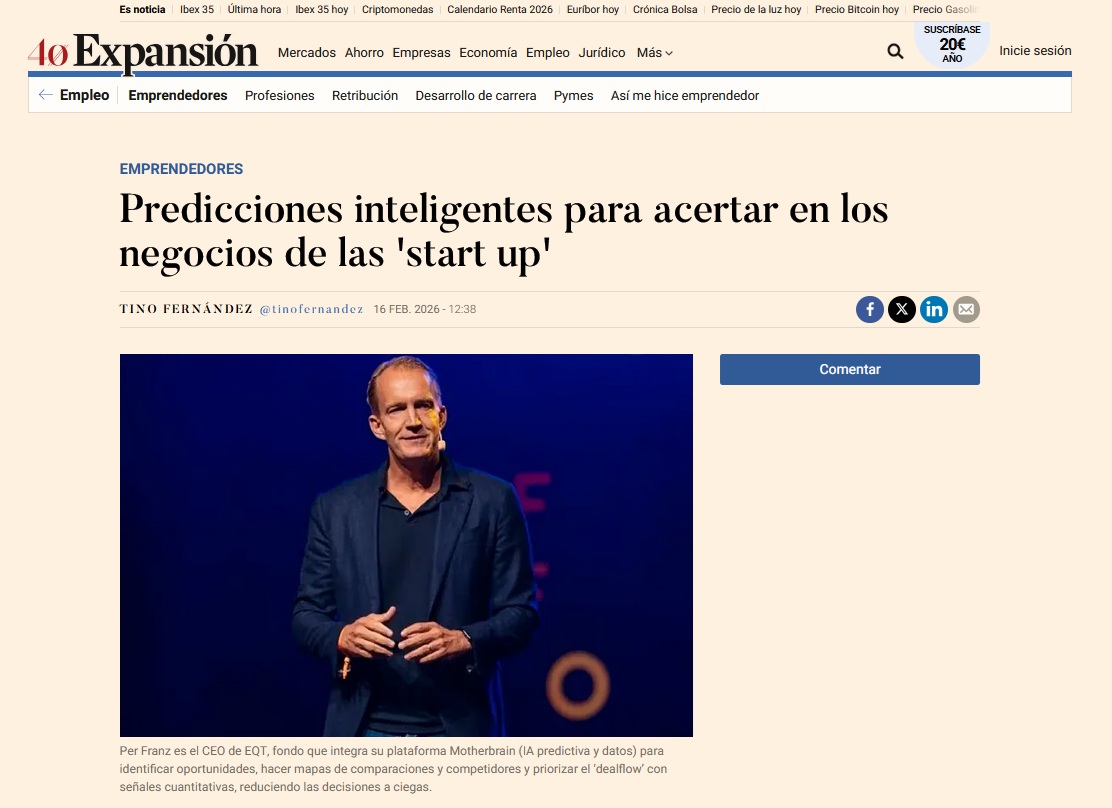
The article explains that while generative AI grabs the headlines, predictive intelligence is quietly transforming the entrepreneurial ecosystem by analyzing historical data to simulate scenarios and estimate probabilities
Rather than being a “crystal ball,” it narrows down the future and helps prioritize decisions in an environment saturated with information and start-ups.
In this context, Mario Garcés argues that the same expectations applied to physics cannot be applied to economics. He distinguishes between linear systems—predictable and governed by formulas—and non-linear systems, such as weather or venture capital, where small changes in initial conditions can drastically alter outcomes. In his view, start-up investing is full of factors that are difficult or impossible to quantify: a founder’s resilience, the chemistry between co-founders, or the ability to pivot without destroying company culture.
Garcés supports the use of predictive intelligence, provided it is used humbly and as a guide rather than a substitute for human judgment. It can help filter opportunities, detect patterns, and prioritize decisions, but it does not replace the irreducible human dimension of venture capital: understanding people and reading context. He also warns that the appeal of predicting the future is almost instinctive in humans, which can lead to both successes and mistakes, and notes that many economic predictions tend over time to approach 50% probability.
Ultimately, predictive intelligence can guide tactical decisions and improve processes, but business success still depends on human judgment, experience, and resilience.